
What Amherst Tax Records Show
Amherst County posts no single screen that merges every assessment field with every payment field. The county links a GIS Property Look-up and a tax page. The Treasurer runs a separate online payment gateway. Search fields and result columns vary by tool. The trail below names each record and its custodian. So you can ask the right office instead of assuming a value, exemption, or balance lives in one place.
| Record Item | What It Answers | Office or Route |
|---|---|---|
| Assessment date and value | What value is on the county roll for the assessment date. | Commissioner of the Revenue. |
| Tax map and parcel description | How the land is keyed for county mapping. | Real Estate & Mapping; county GIS link. |
| Bill, payment, or balance | What the Treasurer billed or received. | Treasurer’s payment gateway or office. |
| Relief application | Whether a local relief request was filed and reviewed. | Commissioner; verify current form. |
| Land-use assessment | Whether an eligible tract receives use-value treatment. | Commissioner’s program information. |
Assessment and payment are separate acts. The Commissioner values the parcel; the Treasurer receives the tax. A wrong bill deserves one first step: confirm the map number and situs match the land. Then ask which office owns the disputed field.
January 1 in Amherst Assessments
Amherst County assesses real estate as of January 1. The county says the Commissioner updates new construction and additions between general reassessments. A value on the roll is tied to that assessment date, while a deed may record a transfer at another point in the year. The research did not locate a typical number of days between recording and roll update. If a recent purchase does not appear, check the newest recorded deed with the Clerk rather than guessing at a county lag.
The county’s online tax and real-estate page describes assessment, relief, land use, map access, and the physical-situs rule. The linked screenshot is from the official Amherst County tax page. It is a program-information page, not a parcel bill result, so use it to identify the right office and ask for a specific account record.
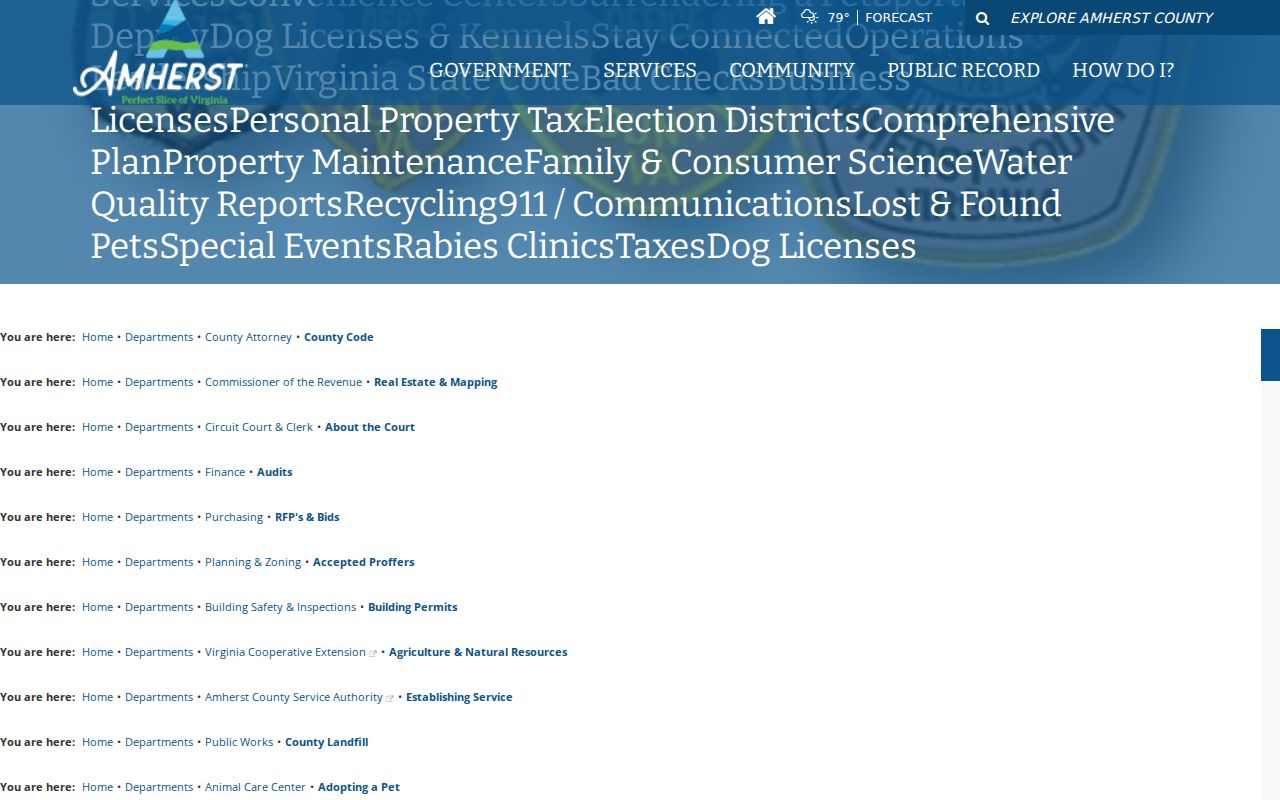
Note: The county page's general text and its later ordinance note show why the date on the current bill deserves a fresh check every year.
Amherst Treasurer Bills and Payments
The Treasurer's portal at countyofamhersttax.com handles online payments. Its landing page does not display every lookup field, prior-year coverage, payment history, or delinquency column. A landing page alone confirms no account balance. Rely on a current bill, a receipt, or direct word from the Treasurer for the parcel in question. Checks and money orders go to P.O. Box 449, Amherst, Virginia 24521.
The Amherst County Treasurer's payment gateway is the payment route itself. It shows no sample parcel result. The county publishes no guide to how a user searches by address or account number there, so ask the Treasurer before assuming.

Call the Treasurer for payment status or delinquency. Call the Commissioner for assessment and tax-map matters. That split saves real time when a bill and a parcel card disagree.
Installments and Amherst Tax Due Dates
The county page keeps older text listing June 5 and December 5. But a later ordinance note moves the first real-estate installment to July 1 beginning in 2022. December 5 remains the second due date. The county also warns that a bill you never received still accrues penalty and interest. Copied pages can retain stale language. Check the current bill or the Treasurer for the year you are paying.
A tax rate resolution and other county documents sit in the 2025 Document Center. The amount due shifts with the adopted rate, assessed value, exemptions, and account history. A deed's consideration tells you nothing about the current bill. A tax payment is not evidence of ownership. A sharp Amherst County property tax records request names the tax year. It also asks whether the figure is billed, paid, or still due.
The 2020 Amherst Revaluation
The most recent fully described Amherst County reassessment notice took effect January 1, 2020. The one before it took effect January 1, 2014. That study began in July 2018 and drew on 2018–2019 market data. According to the notice, value analysis weighed location, views, highway access, shopping and schools, construction costs and quality, condition, building types, and neighborhood and county market conditions.
The notice adds that sales far above or below the average may be excluded when family ties or unusual circumstances made the price unrepresentative. A county search result lists a 2025 real-estate reassessment document. Its accessible text does not state the effective year or the full schedule. Before calling 2020 the current assessment cycle, check the newer material with the county.
Amherst Relief and Exemption Records
Amherst County offers real estate tax relief for elderly and disabled residents. Applicants must be age 65 or older by January 1 or fully disabled. Household income must stay below $50,000, and net worth below $150,000. Applications run each year from January 15 through March 31 with the Commissioner. A 2025 form sits in the county Document Center. Thresholds and dates can shift, so confirm them against the current form before filing.
The tax-relief form asks for the street address, subdivision, section, block, and lot. It also requests acreage or square feet, assessed value, and tax. It collects private eligibility details too. Keep sensitive applicant fields out of any public parcel example. A blank form shows the office's terminology. It is not an assessment card. It proves nothing about what a parcel was approved for.
Amherst Land-Use Assessment
Amherst County's land-use program covers three categories. Active agricultural or horticultural production requires at least five acres actually in production. Forest land needs twenty acres. Open space is narrower. It is reserved for land dedicated to public uses such as parks, golf courses, or game preserves. Idle or vacant land never qualifies. Confirm program details with the Commissioner before betting an application decision on them.
Sign-ups run September 1 through November 1. A fee applies. Taxes cannot be delinquent. Conversion or rezoning to a more intensive use can trigger rollback tax. Owners must report a qualifying change within 60 days under the county program summary. Ask the Commissioner for the current fee schedule and the application. Also ask about the tax consequences for your specific tract.
Appeal an Amherst Assessment
A 2019 county notice spells out the grounds for an appeal. An owner can contest an assessment that exceeds market value. An owner can also contest one that falls out of line with similar property. A mere percentage increase over the old value is not enough. Follow the hearing instructions printed on the Notice of Real Assessment Change. Bring that notice plus supporting records. The county publishes no current appeal deadline or Board schedule in a general form. Rely on the notice itself. Confirm timing with the Commissioner rather than a generic date.
- Compare the parcel description and assessment year to the land and current roll.
- Gather the notice, deed or sale facts, photographs, and comparable-property evidence that speaks to value or uniformity.
- Contact the Commissioner for the current hearing procedure and file by the date on the notice.
- Keep the decision and any later Board of Equalization record with the parcel file.
Use the notice deadline. Amherst appeal timing is tied to the assessment notice and current procedure. The research did not verify a fixed countywide deadline for every year.
Tax Situs and Delinquency Checks
Amherst County taxes property by its physical situs. The owner's home address does not control this. A mailing city can read Amherst. The parcel may still sit outside town limits. An owner can also receive a bill at another address. Identify the land through the county parcel and map before comparing tax records. ZIP geography and mailing labels never settle a town boundary.
The Treasurer's landing page offers no online delinquent list or payment-history coverage. Ask the Treasurer directly for a current balance and payment record. Then check the Clerk for any recorded judgment, tax-sale instrument, or related court filing. An unpaid bill is not a completed sale. A tax page is not a title record.
Amherst Tax Record Limits
Assessment, tax, relief, and payment records each answer a different question. The Commissioner handles valuation, maps, and applications. The Treasurer handles bills and payments. The Clerk holds deeds and permanent land records. When the county portal cannot answer a focused question, Virginia FOIA can request an existing non-exempt record. It may allow actual-cost charges. It never forces the county to build a new tax history report.
To compare the assessment number with market or sale price, see the separate value explanation. For a parcel transfer, trust the recorded instrument, not a tax bill.
Amherst Delinquency and Tax Sale
The Treasurer's payment page publishes no public delinquent-tax list, payment-history range, or sample account result. Request the current balance and prior payment status using the address or tax-map number. Then ask the Circuit Court Clerk about related records. Ask whether any judgment, notice, or tax-sale instrument was recorded. A delinquent bill marks a debt. It does not prove a sale occurred or that ownership changed.
For due diligence, keep each record type separate. Track the bill year, amount due, payment receipt, recorded lien or judgment, and any later trustee or tax-sale deed. Amherst County's Document Center is searchable by department and year. Use it for tax-rate resolutions and related public records. If a list or account history is not online, file a focused Virginia FOIA request for the existing record. Then request an actual-cost estimate before any broad search.