
Where Amherst Owner History Begins
Ownership research in Amherst County can reach back to 1761, when the county was formed. No verified online coverage year exists. So the archive route offers the true depth of record. For each transfer, record the parties, date, and instrument type. Also note the book and page, parcel reference, and description. A street address alone grows weak for older land.
| Source | Coverage Located | Where Held | Use in the Chain |
|---|---|---|---|
| Newest recorded deed | Current instrument; online cutoff unverified. | Amherst Circuit Court Clerk. | Names the latest grantee and tract. |
| General deed indexes | 1761–1924. | Library of Virginia microfilm guide. | Find earlier parties by name. |
| Deed Books | Book A begins 1761; later volumes through 1903 in listed reels. | Library of Virginia and Clerk records. | Read the full conveyance and boundaries. |
| Plat Books | 1761–1930 in two indexed books. | Library of Virginia / recorded land records. | Connect lot lines and subdivision changes. |
| Deed and will abstracts | Museum service lists local abstracts. | Amherst County Museum. | Lead to known names or book/page requests. |
Begin with the most recent deed you hold. Move to an earlier source only when its citation or grantor demands it. The Clerk of Court stays the official custodian for any certified instrument.
Walk Amherst Deeds Backward
In every deed, the grantee receives the interest and the grantor conveys it. Say the current deed shows A conveyed to B. Search for the earlier deed that vested A. Then repeat the step, transfer by transfer. This approach traces former owners without mistaking a tax roll for a title history. Confirm at each link that the instrument describes the same tract through acreage, adjoining owners, roads, streams, plats, and cited prior book and page.
| Transfer 1 | Current grantee receives from the latest grantor; record date and reference. |
|---|---|
| Transfer 2 | Search that grantor as a prior grantee; compare legal description. |
| Transfer 3 | Follow the earlier grantor, including any trustee or executor role. |
| Transfer 4 | Continue into the relevant deed book or microfilm index. |
- Copy all names and deed references from the newest recorded instrument.
- Search the grantor’s earlier acquisition, using name variants and date range.
- Check each description against the parcel, plat, and boundary calls.
- Follow any estate, trust, corporation, or court capacity shown.
- Stop when the index ends, the tract changes, or a professional title search is needed.
- Grantor
- The party who transfers an interest.
- Grantee
- The party who receives it.
- Chain of title
- The connected series of instruments that affected ownership.
- Reverse index
- A way to search the recipient of one deed as the transferor in an earlier deed.
Amherst Online Cutoff Is Unknown
Amherst County offers no public grantor-grantee index URL. There is no confirmed online cutoff, result limit, or image coverage period. Virginia Courts runs a secure land-record service for select courts. It requires registration with the local Clerk. Call it a restricted route, not an open public deed search. Ask the Clerk directly whether a given date range can be searched remotely or at the courthouse.
When a search stops returning deeds, the chain has not ended. The wall may reflect an access rule. It may also reflect a name variation, a missing image, or an index gap. Request the instrument by party, approximate date, parcel, or book and page. For older periods, turn to the Library of Virginia index sequence.
Amherst Book A and the 1761 Start
Amherst County was cut from Albemarle County in 1761. Library of Virginia microfilm opens with Deed Book A, covering 1761 to 1765. Its index series run 1761–1815, 1815–1843, 1843–1885, 1885–1903, 1904–1917, and 1917–1924. General Index Vol. 6 continues through W–Z for 1917–1924. Plat books start in 1761 and run through 1930 in the finding aid.
The Library of Virginia Amherst finding aid lists every reel, book, index, and plat holding. It is a catalog, not an image collection. Some entries carry availability marks that the archive must confirm.
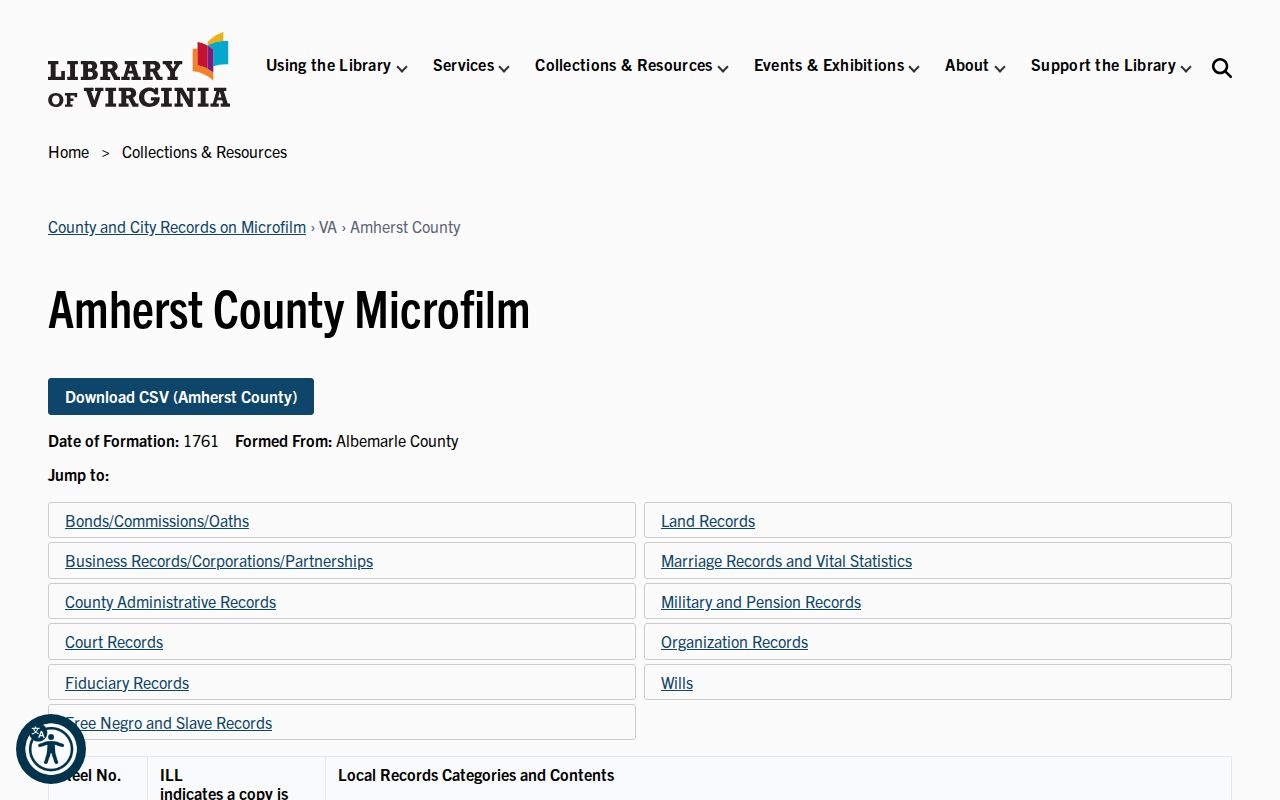
Keep the archive call number and reel details in your notes. That way the earlier owner can be checked in the correct volume.
What Old Amherst Deeds Say
Old Amherst County deeds can name the grantor's and grantee's residence, the consideration, and tract location. They may also list boundaries, limitations, signatures, witnesses, and a prior book and page. The ARVAS collection description covers deeds from 1771 to 1894. Most fall between 1797 and 1871. It catalogs bargain-and-sale deeds, gifts, mortgages, bills of sale, and deeds of trust. Plats appear in some records.
The ARVAS description of Amherst deeds catalogs historical materials rather than a modern owner lookup. Some documents record enslaved people through bills of sale or deeds of gift. Describe that history accurately and with care.
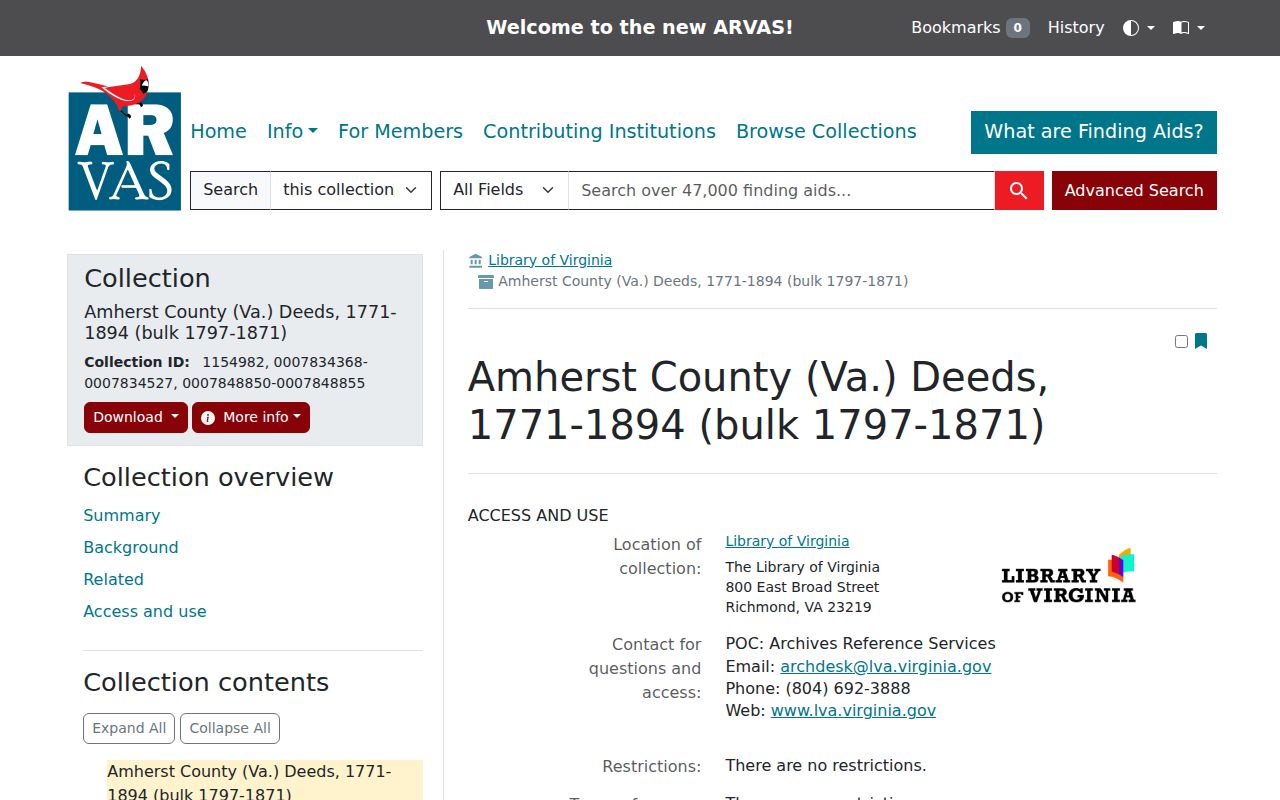
Older legal descriptions often identify a tract by stream, old road, neighboring owner, or acreage. Preserve those references rather than forcing a modern street name onto them.
Use Amherst Plats to Repair a Gap
A chain can seem to break when a farm was split, merged, or renamed as a tract. The Clerk records plats. The LVA guide lists Plat Book 1 for 1761–1803 and Plat Book 2 for 1803–1930. Search the cited plat by book and page. Compare lot dimensions, road reservations, easements, and adjoining land. Never trust the current tax-map number alone, since map maintenance can change it.
Town of Amherst Chapter 18.1 governs subdivision review and plat vacation. A later vacation or boundary adjustment may explain why an early lot map no longer matches the parcel shape. Check the recorded instrument and the planning file. Then follow the modified tract through the deed chain.
Estate Transfers and Amherst Names
A former owner may have passed land through an estate rather than a sale. The Circuit Clerk keeps wills and estate records. LVA lists Amherst County will books from 1761 onward. Early books and later volumes include some incomplete indexes. A will, fiduciary account, or qualification can explain a missing seller. So can a court order, partition, or executor's deed. Follow the name and the role stated in the document.
Search spelling variants, initials, married names, and trust or corporate suffixes. The grantee may have acted as executor, trustee, commissioner, or company. Search that role rather than the person's everyday name. A gift, dower release, or partition may show nominal consideration without being an ordinary sale.
Amherst Museum Document Retrieval
The Amherst County Museum handles research that reaches back before modern indexing. Its abstracts cover deeds, wills, marriages, and birth and death material from 1854 through 1896. A single genealogy request covers one to three individuals. Staff will photograph up to five courthouse documents at no added copy charge. Extra photographs cost $2 each. A separate known-document retrieval fee applies, and it is tiered. The price depends on the request size. It may cover one document, two to five, or six to ten. Requesters must supply a record type, names, book, and page.
The service suits anyone chasing a deed or will. A name or citation must already be in hand. It cannot guarantee a result, and it is no substitute for certified title work. Details appear on the museum's genealogy and retrieval service page.
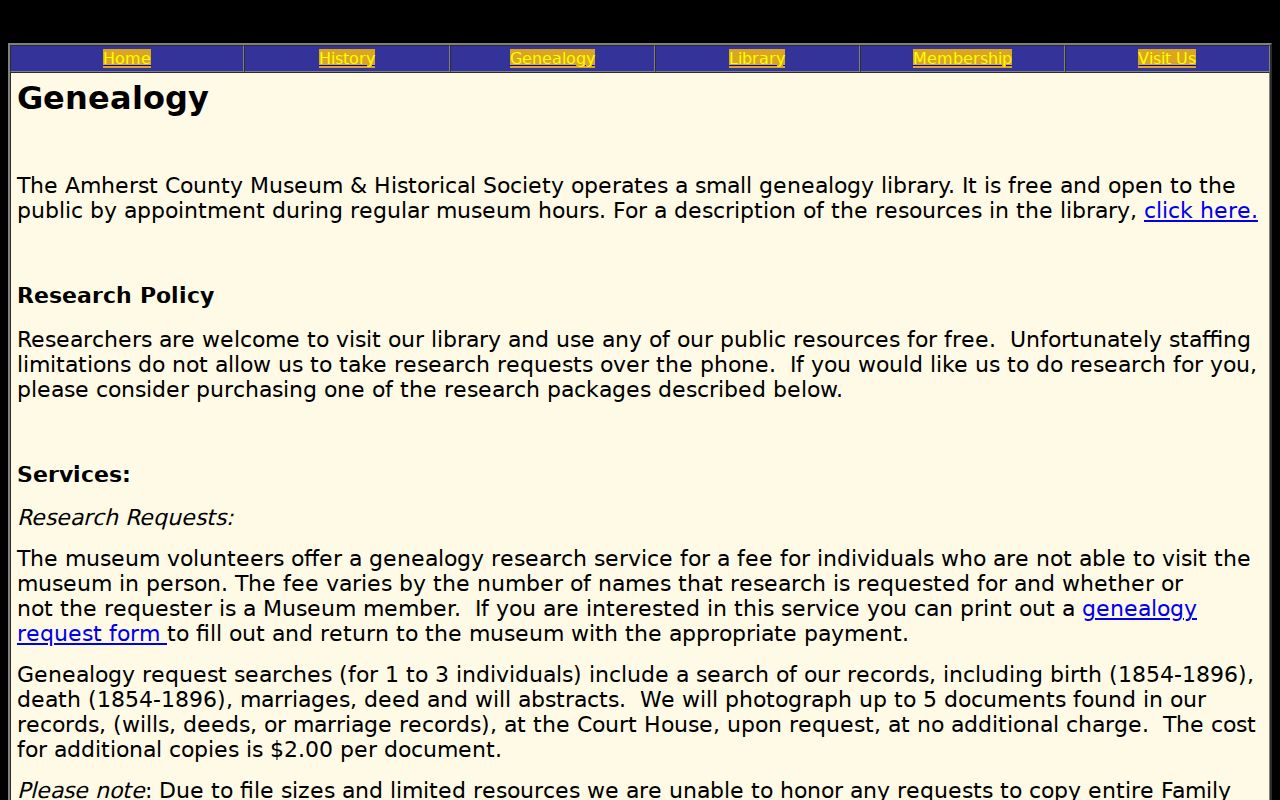
The Library of Virginia serves as the statewide fallback for microfilm and archive questions about Amherst County property records. Contact the archives desk at archdesk@lva.virginia.gov or (804) 692-3888.
Former Owner Search Limits
An online index alone cannot promise a complete deed chain. Amherst County's public index has a cutoff. Its reach is not published. Older records may also spell the same name several ways. Beyond deeds, land changes hands through probate, partition, boundary actions, and corrective instruments. Match the actual tract and read the full record. A short search result is not enough. For a certified opinion on ownership, rely on a title professional.
Use history with care. Former-owner research supports house history, genealogy, and title work. Do not use names or addresses to track, harass, or harm a living person.
Follow Old Amherst Property Descriptions
Old deeds rarely use a modern street number. A historical Amherst County deed may instead describe land by its former owner. It may also cite a farm or tract name, adjoining owners, a watercourse, a road, or metes-and-bounds calls. When an old description will not match a current address, keep the original wording intact. Follow the cited book, page, grantor, and grantee into the next instrument. A later deed may repeat only part of the boundaries. Compare adjoining names and acreage too. The chain of parties matters as much as the lines on paper.
Amherst County's historic plat books can help you locate an older subdivision or land division. The Library of Virginia finding aid describes what these volumes cover. It does not guarantee a scan of every page. Ask the archive or the Clerk how to obtain the volume or image you need. The Museum's genealogy and document-retrieval service can also search selected courthouse materials. That help is subject to its stated scope and fees, and with no guarantee of a result.
Record every link in the chain with its source and date. Similar names, family ties, and a shared tract label are leads to test. They are not proof that two references describe the same owner or parcel.