
Start an Amherst County Property Search
The tax-map number is the best first key. Start with a street address in the county's GIS Property Look-up. If the page will not load, that proves nothing about the parcel. Online services go down. The Commissioner of the Revenue's Real Estate & Mapping Division can identify a tax map from an address. Write down every detail the source shows: map number, situs, owner name, mailing address, subdivision text, acreage, and assessment figures. Those fields anchor everything that follows.
Then match that identifier to the land record. A deed may cite an old tract name, acreage, road, stream, neighbor, or plat reference rather than a modern street address. The tax roll and the deed answer different questions. One is an assessment record. The other documents an instrument the Clerk accepted. A tax payment page offers a third path, and this Amherst County property search sequence keeps those roles separate.
- Write down the complete address and check whether the parcel is inside the Town of Amherst boundary.
- Ask the Commissioner for the tax-map number if GIS lookup is unavailable.
- Use that number to connect the parcel map, assessment, and any town planning file.
- Confirm a transfer in the newest recorded deed held by the Circuit Court Clerk.
- Use the Treasurer for balances and payment history, and ask the custodian about copies.
Amherst County Property Records Offices
Three county offices divide the core record trail. The Amherst Circuit Court Clerk records deeds and other permanent court records, while the Commissioner of the Revenue assesses real estate and maintains the tax maps. The Treasurer collects the tax bill. The county seat is also the Town of Amherst. The Town itself runs no separate recorder or assessor, so town land-use history comes from the Town Manager's zoning files layered onto the county records.
Amherst Circuit Court Clerk
113 Taylor Street; P.O. Box 462
Amherst, VA 24521
(434) 946-9321
Weekdays, 8:00 a.m. to 4:30 p.m.
Commissioner of the Revenue
Real Estate & Mapping
100 Goodwin Street, Amherst, VA 24521
(434) 946-9310
Amherst County Treasurer
Mail: P.O. Box 449
Amherst, VA 24521
Real-estate tax bills and payments
Amherst Deed Books Begin in 1761
Amherst County was formed from Albemarle County in 1761. Deed Book A, covering 1761–1765, opens the record. The Library of Virginia's microfilm finding aid traces the deed books onward through later lettered and numbered volumes. General deed indexes run from 1761 to 1924. Plat books span 1761 through 1930. That depth makes an old deed chain possible even without a modern online index, though the finding aid lists reels rather than promising a web image for each one.
Work backward carefully on a historic tract. Note every book and page reference first. Record name variants, acreage, boundary calls, and each cited prior deed before stepping back another generation. Old deeds may name a stream or a neighbor. The collection holds more than deeds. Deeds of gift, bills of sale, mortgages, and deeds of trust fill the books alongside them. Some historic documents record enslaved people sold or gifted as property; quote and interpret those records with care and context.
The Library of Virginia's Amherst microfilm finding aid lists the books, indexes, and plat reels. The Amherst deed collection description adds detail on the instruments and descriptions held. Neither sets a current deed-index cutoff for the county.
Four Amherst Property Record Trails
Amherst County keeps no single property database. The office and the record type decide what a result can prove and how to obtain it. A tax map, an assessment card, a deed, and a tax bill may carry different names or dates for the same parcel of land. That difference shapes which trail to walk first.
| Record | Question It Helps Answer | Custodian or Route |
|---|---|---|
| Deed and deed of trust | Who conveyed an interest, and what instrument was recorded? | Circuit Court Clerk; secure remote access requires local registration. |
| Assessment and tax map | How is the parcel described for assessment and mapping? | Commissioner of the Revenue, Real Estate & Mapping. |
| Bill and payment | What tax was billed or paid? | Amherst County Treasurer. |
| Plat and boundary instrument | How were lots, lines, easements, or roads laid out? | Clerk’s land records, plat books, and local planning files. |
| Permit or zoning file | What construction or land use was reviewed? | County Building Safety and, inside town, Town of Amherst zoning. |
Use the Amherst deed-records route for the recorded transfer itself. Assessment appeals follow a separate tax process. Tax relief, installment dates, and appeals all run through that path, while a permit file may describe work without ever changing the deed's legal description.
Amherst GIS Lines Need a Deed Check
The county names its linked service GIS Property Look-up. Its tax page says tax maps may be viewed through Real Estate & Mapping, and the Document Center also links a Maps and ArcGIS experience. The GIS host does not load dependably. Its exact layers, owner fields, search modes, print options, and update date remain unconfirmed. Treat each link as an access route to try, not a guaranteed result.
County tax-map identifiers mix letters, numbers, and suffixes. Examples include 155D-A-44, 147-A-212A, 137-A-157, 160A2-5-B, and 160A2-4-2. These are sample identifiers only. They offer no decoder and no town-only prefix. If the viewer is down, give the Commissioner of the Revenue the address and any known parcel reference, then ask about an office tax-map view or copy.
- Parcel
- A mapped tax unit used to connect land to assessment and mapping records.
- Plat
- A recorded drawing that can show lots, dimensions, roads, and easements.
- Situs
- The physical location of the land, which may differ from the owner’s mailing address.
Reading Amherst County Tax Dates
Amherst County sets its real-estate assessment date at January 1. Between general reassessments, the Commissioner of the Revenue handles new work. It values new construction and additions as they arise. The county tax page still carries older June 5 language. A later ordinance note changes that. It moves the first real-estate installment to July 1 starting in 2022. The second installment stays December 5. Missing a bill does not erase penalties or interest. Before paying, check the current bill or the Treasurer. A page excerpt is not an account balance.
The most recent fully described revaluation notice took effect January 1, 2020. The one before it was effective January 1, 2014. It drew on 2018 to 2019 market data. Amherst County also indexes a 2025 reassessment document. Its title alone, though, does not establish an effective year or schedule. Treat the current cycle as unconfirmed until the document itself states it.
Assessed value, the county explains, is meant to reflect full fair market value. The tax bill is a separate matter. It also turns on the adopted rate and any relief that applies. A careful Amherst County property search records two years. It notes the assessment year separately from the tax bill year.
The county's real-estate and tax page pulls the assessment date, map access, and relief together. It also gathers installment rules in one place.
This overview names the offices and the rules that govern them. For any single parcel, though, the current bill or assessment record is still the document to check.
Amherst Tax Map and Tax Situs
Real-estate tax in Amherst County follows where the property physically sits. It does not follow where the owner lives. A mailing address can point to a different town. The one named on the map may differ. An Amherst mailing city or ZIP proves nothing, in other words. It does not show whether a parcel sits inside the incorporated Town of Amherst. Confirm the physical parcel and its boundary. Do this before treating a tax or zoning file as town-specific.
The county's accepted-proffer list links road names, case numbers, tax maps, and dates. Examples include 123 Phelps Road with parcel 155D-A-44. Another is 186 Dillard Road with 147-A-212A. Off Crescent Lane carries 137-A-157. References like these can bridge a planning file to the parcel map. They are illustrations from county material, not live search fields in the GIS portal.
Amherst Permits Cross Two Offices
Substantial construction inside the Town of Amherst goes through zoning review first. The Town Manager serves as Zoning Administrator. For substantial in-town work, a town zoning permit must come first. The county will not issue a building permit before it. The town planning process reaches site plans, subdivisions, special-use permits, rezoning, conditional zoning, variances, appeals, and plat-vacation matters. Depending on the request, an application may need a cover letter, an owner-signed form, plans, and a fee.
Once zoning is settled, the county Building Official administers the Uniform Statewide Building Code. The same office handles permits and inspections. Building Safety sits at 153 Washington Street, Amherst, at (434) 946-9302. The county-linked iWorQ portal handles permit applications. A complete property history can still require both files: the town zoning file and the county inspection file.
FOIA for Amherst Records Offline
Virginia FOIA is the offline route when a portal is missing or a search does not surface the needed item. A request should name the custodian, the address or tax-map number, the record type, the time span, and whether inspection or copies are wanted. You never have to use the word FOIA itself. The public body generally answers within five working days. That answer may provide records, cite an exemption, state that records do not exist, or explain a delay. A permitted extension can add seven workdays after notice.
Charges cannot exceed actual search, duplication, and supply costs. Ask for an estimate before a long GIS or permit search. FOIA does not require Amherst County to build a new parcel report, ownership chain, or index that does not already exist. Confidential records stay under their own rules. A custodian may withhold protected portions while releasing the rest.
Amherst History at the Local Desk
The Amherst County Museum's genealogy service searches birth and death material from 1854 to 1896. It also covers marriages, deed abstracts, and will abstracts. It accepts searches for one to three people. Up to five found courthouse documents can be photographed with no added copy charge. Extra photographs run $2 per document. A known book and page can support retrieval. Separate fees are based on the number requested. The museum cautions that results are not guaranteed.
The Amherst County Public Library began in 1964. Its start came through Library of Virginia demonstration and bookmobile service. Its collection now approaches 100,000 items plus electronic resources. The public branch page does not list exact directory, newspaper, cemetery, or obituary years. Ask staff about those holdings rather than assuming a complete index. For archival questions, the Library of Virginia lists archdesk@lva.virginia.gov and (804) 692-3888.
Limits of Amherst County Records
Know what each record can and cannot tell you. A tax roll lists the owner of record as the county assesses it, but it is not a title opinion. A GIS map line helps you visualize a parcel. It is not a boundary survey. A recorded deed proves an instrument exists, though the deed records may skip an unrecorded interest, and a full chain search may still be needed. Bring the deed and plat to a licensed surveyor for a boundary dispute, and use a title professional with certified land records for clear-title work.
Lawful use. Amherst County records support property research, family history, and civic review. Do not use names or addresses to stalk, threaten, or harm anyone. Verify a finding with the office that holds the record.
Amherst County Document Center Records
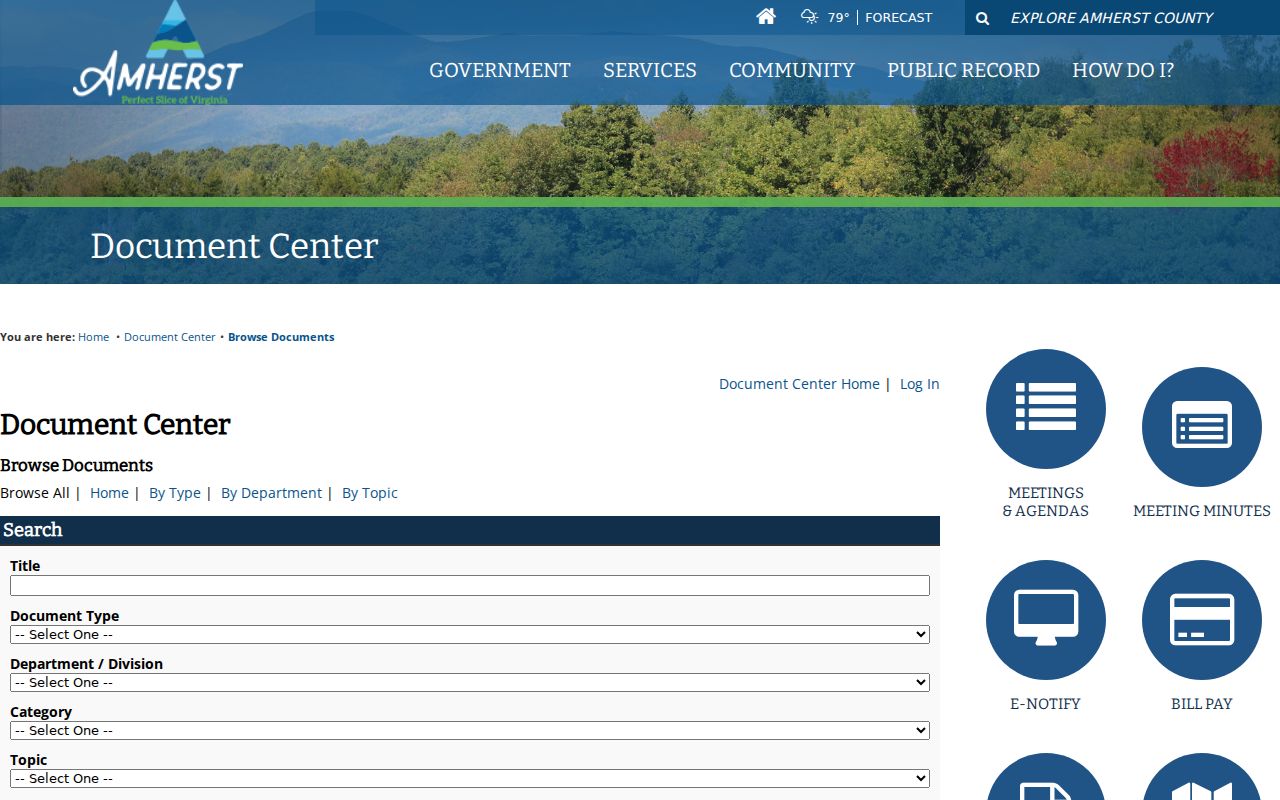
Not every property question ends at deeds or assessment cards. Amherst County's Document Center covers a different lane: resolutions, department materials, planning records. It also indexes other documents. Its filters include Title, Doc Type, Dept/Division, Category, Topic, and Year. That layout rewards a narrow search. A focused title or year query beats a broad one for "property." A record can touch both land use and a department function. Try several categories.
The view below connects to the official Amherst County record and document center. The page lists a 2025 tax-rate resolution. It also lists items tied to Building Safety and Planning appointments. That range shows what gets indexed here. It does not promise a complete permit history for any parcel.
When you ask an office for a copy, bring specifics. Note the exact title, department, year, and document type before you call or write. An item may not be indexed. Request the existing record directly and name the parcel or project. Virginia FOIA opens the door to existing non-exempt records. It cannot force the county to build a new parcel report. It also cannot reconstruct a missing history.
Treat this administrative collection as one shelf in a larger library. The Circuit Court Clerk keeps its own records. The Commissioner of the Revenue, Treasurer, and Town of Amherst each keep their own records too. One project can scatter a deed, an assessment entry, a tax payment, a zoning file, and a building application across separate systems. Checking several custodians pays off.
Route Amherst Records to the Right Custodian
A document-center result may point to a department. Keep that department's name with the file title and year. No published item? Then identify the record series first instead of asking for a broad property history. Custody in Amherst County splits cleanly by function. The Commissioner of the Revenue and Real Estate and Mapping office answers assessment questions. It also answers map questions. The Treasurer holds tax accounts and payments. The Circuit Court Clerk keeps recorded land instruments. The Town Manager's office handles Amherst zoning and subdivision matters. County Building Safety is a separate custodian for county permits.
Give staff a real starting point. Name the address, tax-map number, project or owner name, likely year. Include the record type too. For deeds, add the parties or the book and page when you know them. For a Town file, describe the application type or hearing. Ask whether inspection is available before ordering copies. Ask for an estimate if the search spans several years. Keeping administrative publications, tax data, zoning decisions, and recorded title documents distinct saves effort. This holds even when they all concern one property.